How Things Are Made
TL;DR: AI lowers the barrier to entry. It does not lower the bar for success.
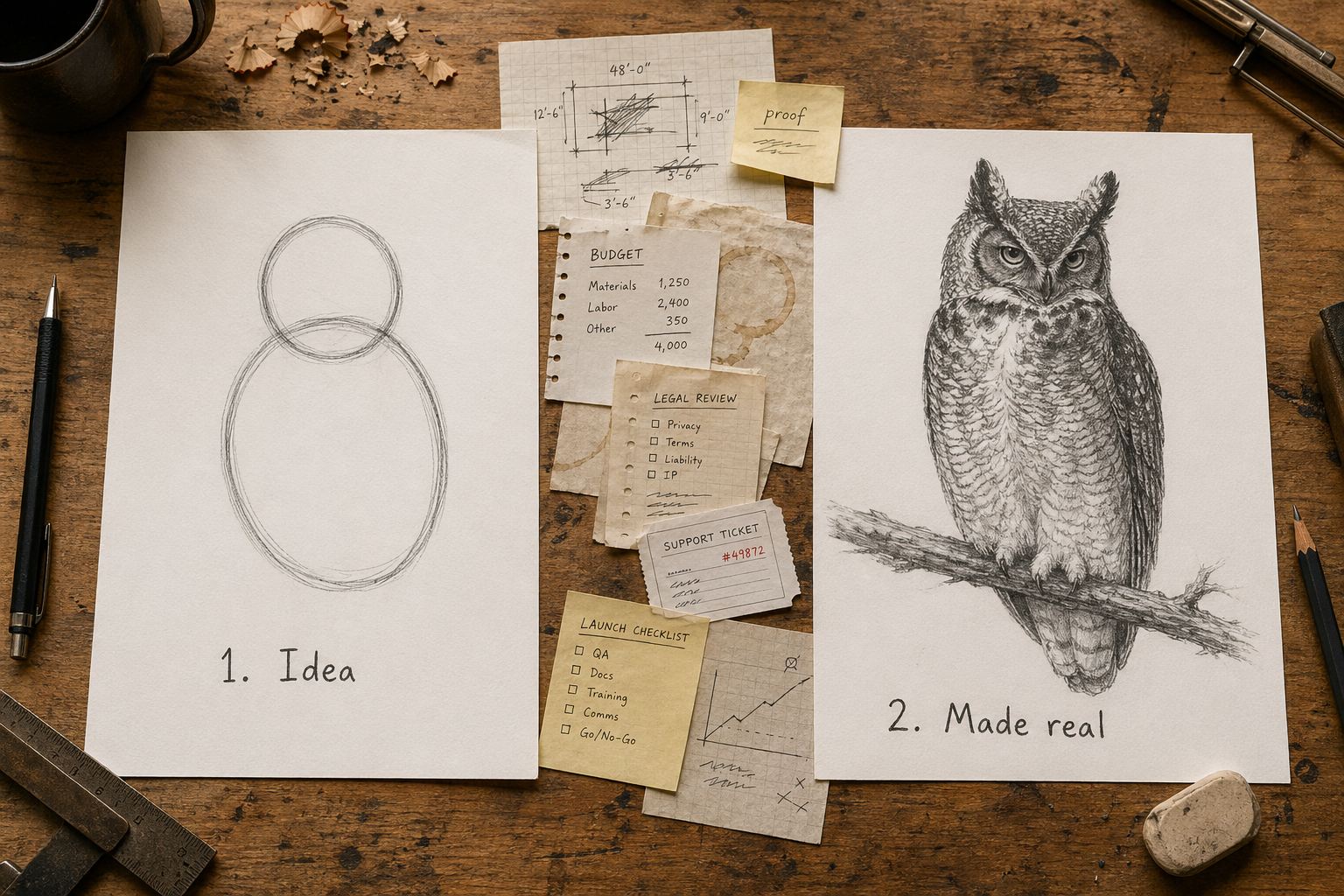
I talk to a lot of AI startups now, and the same pattern keeps showing up.
A few people find a workflow, form an LLC through Stripe Atlas, ask Claude for a financial model, buy the domain, put up a landing page, create an X account, and build a slick demo. Weeks in, it looks more complete than startups before LLMs looked after months.
What it usually does not have yet is customers.
That is not a dunk. The demo is genuinely good. The point is that AI has made rough work look finished before the market has had a chance to touch it.
This is especially seductive outside your own domain. If you are a software engineer or PM asking an LLM for legal questions, the answer can feel astonishing. If you are a lawyer, the same answer may be horrifying. Not because the model is useless, but because you can see where it made the wrong cuts.
That is the part people keep missing. AI changed the tools. It did not change the difference between rough work and finished work.
Rough Cuts
You can cut wood a lot of ways: chainsaw, table saw, circular saw, hand carving knife. They all remove wood. That does not make them interchangeable.

If you are building a birdhouse, you can get away with a lot. A crooked cut becomes charm. A gap becomes ventilation. Paint hides sins. If you are doing finished carpentry, the same mistake compounds: the corner is off, the trim does not sit flush, the shadow line gives you away forever.
Both projects involve cutting wood and joining pieces together. They do not require the same fidelity.
Good builders know which parts can stay rough and which parts need care. Novices often do not. They use the wrong tool, or the right tool at the wrong moment, and end up with something that is close enough to be frustrating and still hopelessly far from the target outcome.
That is how a lot of AI work feels right now. It can get you very close, very fast. Close is useful. Close is not done.
The First Customer
The first demo proves the team can make something. The first customer reveals whether they are making the right thing.
That is where the pivot usually starts. The demo was fine, but the customer exposes a more basic problem nearby, in the same space but with a different center of gravity.
A team automated a really complicated report, but discovering who can actually approve it and providing the context for them to make that decision in a timely way emerges as the real bottleneck. Similarly, perfect follow-up notes are drafted, but nobody knows which to send. The dashboard works; nobody trusts the source data.
Those are not polish issues. The rough cut was useful because it invoked a reaction, but now you need judgment.
The Pattern
I have made a strange range of things: pinewood derby cars, bicycles, millions of square feet of distribution centers, and software features you have probably experienced somewhere on the internet without knowing my name.
The point is not the list. The point is that the path from idea to thing is weirdly consistent.
The sequence is boring and stubborn: start rough, learn what matters, find the constraints, choose where to spend care, build, let reality argue, invest more time than you thought on an unexpected detail, repeat until satisfied (or exhausted).
That is true for a birdhouse, a distribution center, a SaaS tool, or an AI workflow.
The old way of doing this was not sacred. Waterfall was too slow for many kinds of uncertainty. Agile fixed some of that by making learning cheaper and more frequent. AI will probably create another version: outcome-first, artifact-light, faster to simulate, faster to test, faster to discard.
Fine. But the problem of knowing where to spend care remains.
When is rough enough? Where is precision required? Which expert needs to look at this? What are we pretending is finished because the artifact looks finished?
That is the work.
The Trust Problem
This matters because the number of plausible-looking things is rising fast. GitHub reported more than 36 million new developers in 2025, 121 million new repositories, and more than 230 new repositories created every minute. The surface area of software is expanding.
AI lowers the barrier to entry. It does not lower the bar for success. If anything, the bar is going up.
When more people can produce something that looks complete, customers have a harder time knowing what to trust. The artifact is easier to fake. The process behind success is still very hard.
The market will reward teams that know the difference. Taste, context, and follow-through are harder to fake than a landing page.
The Frontier
Knowing which tools work is the LLM equivalent of knowing which candidate to hire for the role. Researchers call this the jagged technological frontier. In one study of 758 knowledge workers, AI helped people complete more tasks, move faster, and produce higher-quality work on tasks inside the frontier. On a complex managerial task outside it, people using AI were 19 percentage points less likely to produce correct solutions.
That is exactly the problem. AI is not one tool. It is a drawer full of tools, many of them unlabeled, all improving, some dangerous in ways that only experience can recognize.
A model can draft a support flow, generate legal questions, and review your PR. It cannot know whether Support is nuking your retention, whether the exposure is acceptable, or whether you are shipping correctly shaped landmines across your codebase.
That does not make AI-powered development a mistake. It makes the tool boundary important to test continuously and obsessively.
So use AI for rough cuts. Use it to widen the review surface. Use it to find the questions counsel, support, and customers would raise. Then slow down where the cut matters.
That is not anti-AI, or even "AI-native" advice. It is how building things has always worked.
Finished Work
The best teams will use AI to get to shape faster. The worst teams will confuse shape with finish.
For a while, both will look fast.
Then customers arrive. The trim does not line up, the data is not trusted, the legal issue is not theoretical, and the support automation erodes your customer base faster than marketing can replace it.
That is when the difference between rough work and finished work becomes obvious.